

For many utility executives, the journey into aerial intelligence begins with cautious optimism. A team acquires their first uncrewed aircraft system, secures initial authorizations, and starts capturing corridor data. Yet, many organizations find themselves stuck in what industry leaders call pilot purgatory. They’ve proven the technology works, and now the harder question is how to turn one successful flight into a program that runs across the entire network. How do modern utilities bridge the gap between running isolated drone flights and managing a full-scale aerial intelligence network?
The answer lies in understanding that owning hardware and achieving network scale are two distinct milestones. By looking at progressive industry leaders like American Electric Power (AEP) and Florida Department of Transportation (FDOT) we see a powerful blueprint. These organizations operate as both hardware customers and active consumers of Drone-as-a-Service (DaaS). By combining internal asset ownership with outsourced scale, they are rewriting the playbook on how utilities modernize infrastructure inspections.
What Does Owning a Single Aircraft Actually Teach Your Team?
When a utility invests in a single Sentaero 6 system and dedicated payloads, the primary benefit is not massive mileage capture on day one. Instead, it is an invaluable operational education in long-range BVLOS utility operations. Operating one Sentaero 6 gives an internal team direct experience with the realities of running a long-range BVLOS drone program, from hiring the right personnel and establishing safety protocols to managing flight planning, maintenance, and regulatory compliance.
Despite presenting initial learning curves, this hands-on approach builds vital institutional knowledge. Your team learns how to manage data flow, integrate software tools, and document every flight meticulously. However, a single-system approach has natural limitations. It shows your team what it takes to operate safely, but it does not showcase how much operational work the technology can accomplish across thousands of miles of transmission and distribution lines.
How Can Layered DaaS Accelerate Your Program Scale?
While your internal team is learning the ropes, mastering workflows, and gaining regulatory confidence, scaling up immediately can strain internal resources. This is where layering in Drone-as-a-Service becomes a powerful catalyst. Instead of building a full flight department from scratch, DaaS lets an experienced partner show you what network-scale operations look like in practice.
While internal staff handle localized inspections and event triggered responses, dedicated external teams can deploy multiple BVLOS systems simultaneously. This dual approach helps programs jump from capturing 1,000 miles of transmission corridor in a single year to covering 3,000, 6,000, or even 9,000+ miles. More importantly, it gives your data management team the high-volume inflow needed to stress-test your analytics pipeline and ensure your software can handle enterprise-grade intelligence.
What Are the Economics Driving This Transition?
As operations managers evaluate these programs, the financial imperative is impossible to ignore. Traditional helicopter patrols cost between $1,200 and $1,600 per mile, accompanied by high carbon footprints and significant personnel risks. In contrast, advanced Beyond Visual Line of Sight (BVLOS) operations using platforms like the Sentaero 6 + EdgeDock, reduce costs to roughly $200 to $400 per mile.
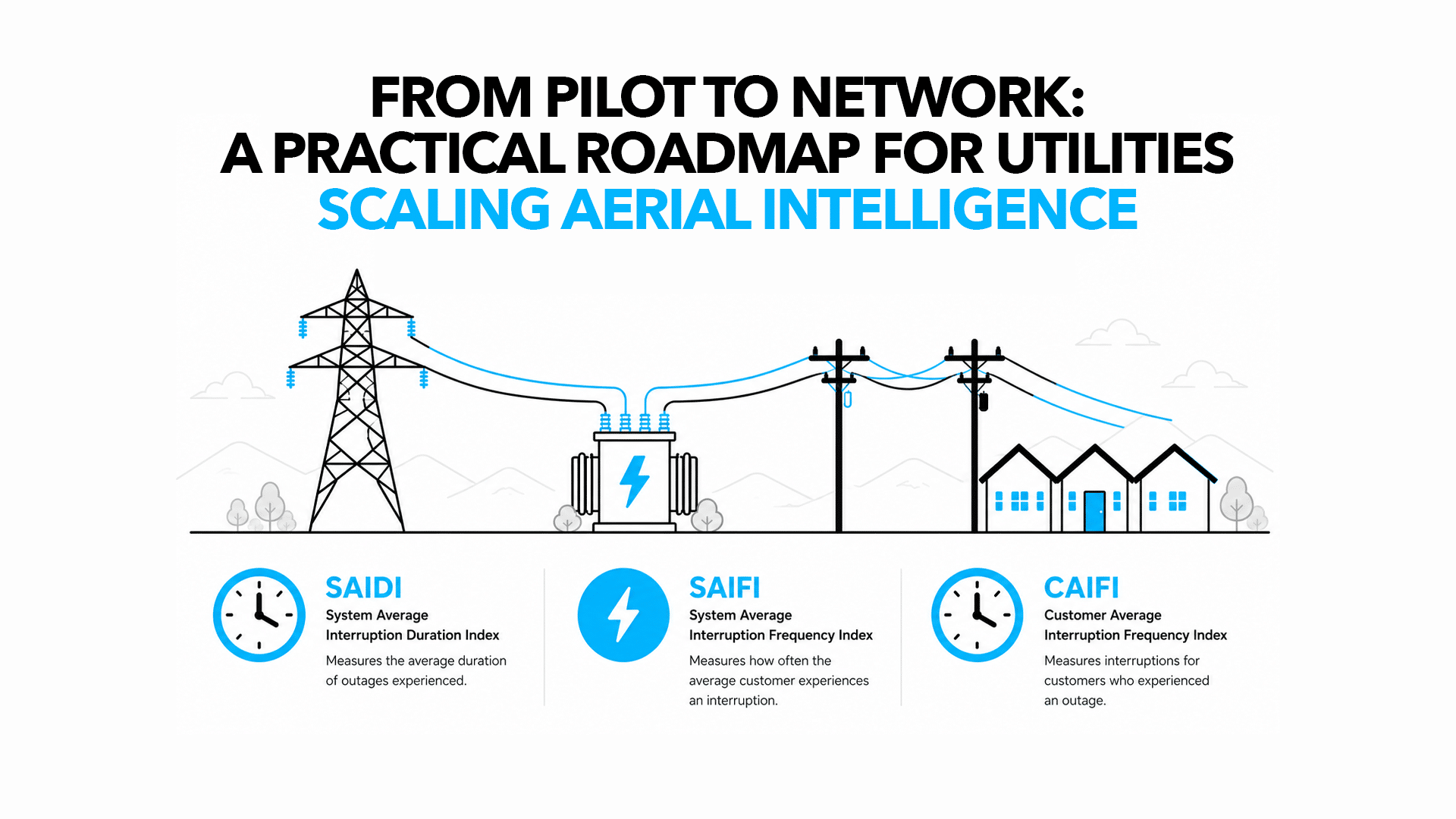
This dramatic shift alters the capital expenditure equation entirely. Utilities adopting this staged roadmap typically see a complete return on investment within 12 to 18 months. When BVLOS inspection data directly moves your SAIDI and SAIFI scores, the case for expanding the program stops being a conversation about cost and starts being one about results.
Which Long-Term Model Fits Your Utility Best?
This layered methodology leaves executive leadership with clear answers and three distinct paths forward for the future of their aerial program. Some utilities decide to invest in a full internal hardware fleet and scale up their own pilot teams. Others determine that outsourcing the entire workflow via DaaS provides maximum agility with zero capital expenditure.
However, a third option is gaining significant traction across the utility sector: the permanent hybrid approach. By outsourcing the bulk of routine corridor mapping through DaaS while retaining ownership of one or two aircraft in-house, utilities achieve the best of both worlds. The internal team remains ready for immediate, event-triggered storm response, high-risk area monitoring, and constant spot inspections, while the broader network runs seamlessly.
Not sure where your utility stands today? Start with our Utility Aerial Intelligence Readiness Assessment to benchmark your program maturity and identify the right path forward. Then, when you’re ready to take the next step, reach out to our team at Censys Technologies to schedule a consultation and explore your proof of concept today.